Showing posts with label J.G. Farrell. Show all posts

Sunday, October 14, 2018

Booker Book #40: The Sea [Again] by John Banville


Apparently, when white British males feel alone, they head for the sea. In this fortieth Booker Prize winner, The Sea, by John Banville, the protagonist Max is recently widowed, and returns to the seaside scene of his first childhood love. Looking at just those bare bones, this book has much in common with The Sea, The Sea by Iris Murdoch. However, despite their similar names, the books could hardly be more different. While Murdoch's novel is a frenetic romp, Banville's is all melancholy lyric and languor.

Banville’s book is also similar to Holiday by Stanley Middleton, in which a man struggling with his marriage seeks solace at a childhood sea resort; and even with Troubles, by J.G. Farrell, in which the Irish conflict impinges on another seaside resort and young romance.

At The Cedars, the house once rented by his childhood love's family, Max wrestles with his increasingly unreliable memory and retells, haltingly, two stories of loss: that of his wife Anna, and that of his first love Chloe.

The writing is beautiful and poetic. Banville makes up words like “coldening” unselfconsciously while waxing philosophical on the meanings of life and death, memory and imagination. And the plot twists are as breathtaking as an undertow.


Monday, March 19, 2018

Booker Book #9: Heat and Dust, by Ruth Prawer Jhabvala


Ruth Prawer Jhabvala's Heat and Dust is an excellent follow-up to J.G. Farrell's The Siege of Krishnapur. Siege is about the Indian Rebellion of 1857. In it, a British official, the Collector, is able to imprison the local Indian prince and his prime minister. In Heat and Dust, the British and Indian rulers seem to be on more equal footing, but their dance is delicate and easily thrown off balance.  

Heat and Dust’s double narrative is original and thought-provoking. The frame story is that of an unnamed contemporary woman researching her grandfather’s first wife, Olivia. Olivia’s story takes place in 1923, in the uneasy decades between the Rebellion and Indian Independence ninety years later. The narrator makes clear from the first sentence that Olivia “went away” with the Nawab, the prince of the region next to the one that her British husband manages. The dual mysteries are how an Englishwoman came to such an extreme, and whether her step-granddaughter will follow in her footsteps.

Jhabvala constructs artfully parallel lives for the two women, yet with striking contrasts due to their differing times. The narrator seems to actually care about the natives, performing acts of charity that repel her higher-caste Indian friends, while Olivia seems oblivious to all Indians but her prince. The narrator is able to evict the parasitic Englishman Chid from her house, while Olivia must put up with both her husband Douglas, and her lover’s hanger-on Harry. Both women take an Indian lover, but their reactions to their pregnancies are diametrically opposed. Both stay in India. The narrator seems to do so out of love for the country, but it is unclear what Olivia’s motivations are: is she simply too humiliated to return to England?

Olivia’s prince is a pathetic character: he wants to lead a life of adventure, as his ancestors did, but instead is spoiled and dependent upon English people, like Harry, and English things, such as his wife’s two pianos, which are both ruined by the tropical climate. And it is the narrator who takes the initiative with her own shy Indian lover. However, after the military and class conflict of Siege, in which India is treated solely as enemy and servant, it was a great relief to read this more nuanced tale of two women truly interacting with “the Other.”

Thursday, March 1, 2018

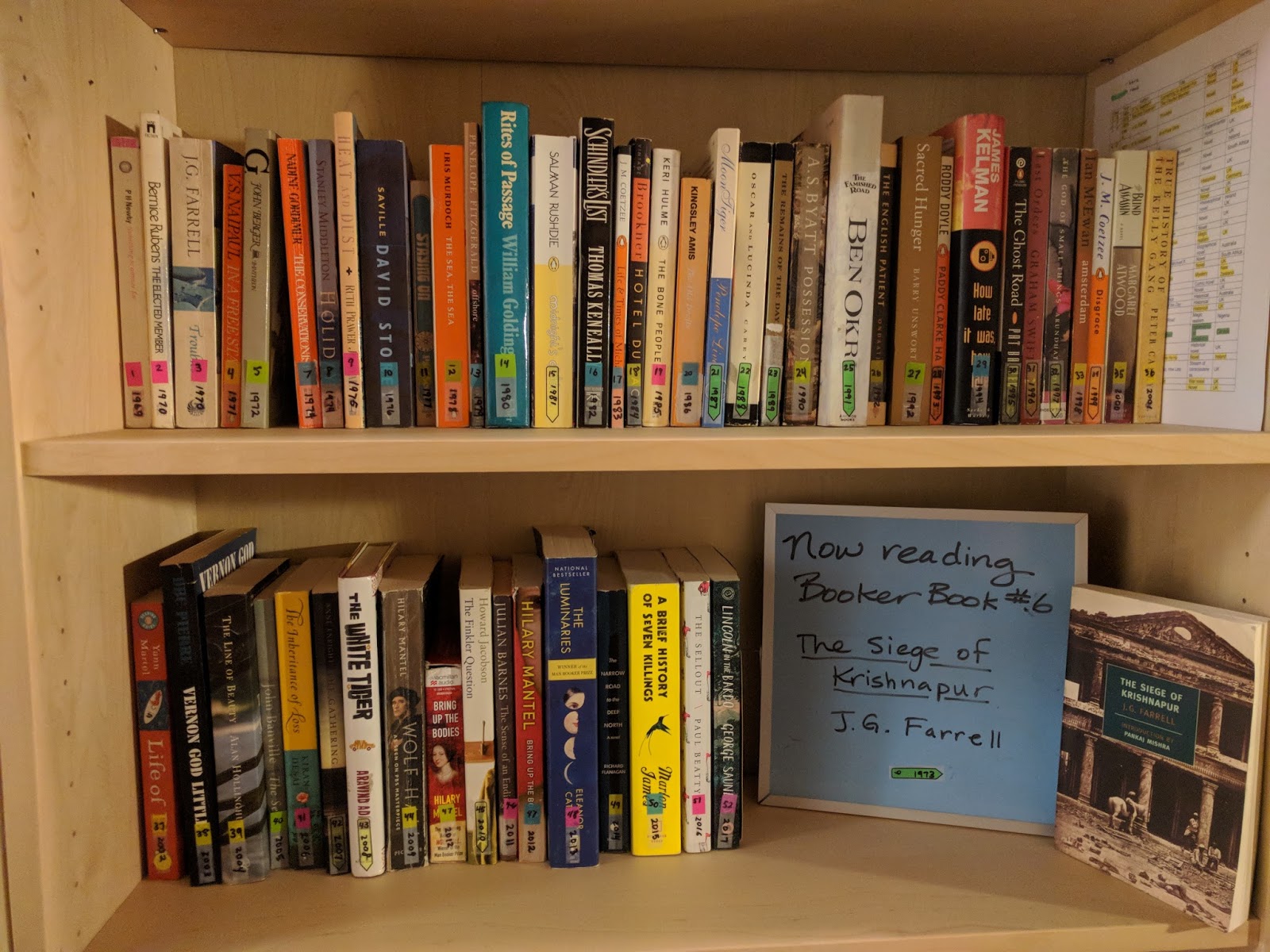
Booker Book #6: The Siege of Krishnapur, by J. G. Farrell

EDIT: It might appear that J. G. Farrell was the first writer to win two Booker Prizes. He won in 1973 for The Siege of Krishnapur, and his novel Troubles holds that honor for 1970. However, the 1970 prize was retroactive. Due to changes in the rules, no prize was awarded for a book published in 1970, until a public vote rectified the situation in 2010. 

Both books are intimate accounts in the form of a microcosm that depicts British colonialism. Troubles takes place in a decrepit English-owned resort hotel in Ireland, while Krishnapur takes place in a “residency” owned by a British trade company at the beginning of India’s own troubles, and is based on actual people and events. Both stories throw strangers together in a siege situation in order to ridicule the notion that the British way is inherently better than the ways of its colonies.

In both the Hotel Majestic and the Residency, the walls literally crumble around the characters, who still absurdly manage to believe themselves better than their “inferiors.” Here, the microcosm is composed of The Magistrate, an atheist and rationalist; Fleury, the aptly named Romantic poet who believes that the most important aspect of religion is feeling; and The Collector, chief of the Residency and self-described “whole” man; as well as a priest, a military man, and two doctors opposed in their methods. Louise, Lucy, and Miriam fill the roles of virgin, whore, and Modern Woman.

The irony is introduced early on, as we find that the British are thriving due to their exports of opium to China – while they spread The Gospel in Asia. The Collector, the Magistrate, and Fleury all believe themselves to be men of ideas – until they are forced by siege-induced famine to daydream of food. Civilization at first seems to mean respecting others’ religions, but then necessity drives the besieged to tear down a mosque. Finally, all must question whether civilization is truly a source of progress, or simply a sign of decay, as all of their fine European belongings are sacrificed to reinforce the ineffectual mud ramparts. The Indian soil literally swallows up all the material things that its oppressors hold dear.

The dueling doctors show that the “superior” British civilization has its own superstitions and blind spots. The two physicians wage a war of ideas over cholera: one has grasped the modern notion that cholera is transmitted through contaminated water, and that the disease can be treated through rehydration. The other clings to the outdated notion that cholera is caught from the air, and can be treated with mustard and brandy. In a moment that had me mentally screaming “No!” the second doctor drinks a bottle of dirty water to prove his point. You can guess the outcome.

More than one of the main characters undergoes a shift in perspective thanks to their ordeal. One of the most enlightened, The Collector, even questions his ideas about the natural inferiority of women, and wonders what he is missing about Indian religion, but never goes so far as to respect the natives.

I enjoyed both books. There is a dry, black, absurdist humor to both, but especially Krishnapur. The bathos of the English aristocracy reduced to sucking on horsehide and shooting pieces of statuary out of their cannons brings home Farrell’s point with wry wit. If I had to choose one, it would be Krishnapur: it is wittier and more action-packed, as well as shorter. But I recommend both for their brutal post-colonial honesty.


PS: I've been reading Booker Books for one month now: 6 books in the month of February, or one book every 4.6 days. A little slower than my usual rate but still on target. 

Monday, February 12, 2018

Booker Book #3: Welcome to the Hotel Majestic. Troubles, by J.G. Farrell

Welcome to the Hotel Majestic, English-owned luxury hotel in Ireland, once grand, now crumbling. Welcome to the sun setting on the British Empire.

Major Brendan Archer, English WWI veteran, has come to the Hotel Majestic in 1919 to make good on a hasty engagement entered into during a brief R&R. Sadly, the young lady has fallen fatally ill, but by the time she passes on, the Major has become as much as fixture in the place as its statue of Venus and can’t tear himself away.

The hotel teems with metaphor: green-eyed ginger (Irish) cats multiply and lord it over hapless (English) dogs, who are fed steak while locals starve. A Sinn Feiner tries to bomb a statue of Queen Victoria. Tropical trees (African and Asian colonies) grow out of control in the Palm Room, tearing down the Empire -- I mean, the Majestic.

The Major, however, stubbornly walks a fine line, trying to maintain the peace and see everyone’s side. Alternately naïve and noble, he counters the reactionary Tory hotel owner with a voice of reason. He’s a likable character, except for his inertia. If he were a real person, I’d be fed up with him after fifty pages, but he is a necessary witness to the quickly declining situation.

Finally, the Major has an epiphany about the owner’s belligerence, and the belligerence of colonists everywhere: they are afraid. Britain is terrified, and lashes out in revenge for all it has lost, blindly overlooking all it has taken from the Irish and the rest of the world.

The tale, as labyrinthine as the old hotel, is punctuated with news items, usually one about “the troubles” in Ireland coupled with one from another hot spot in the soon-to-be-former British Empire, such as India or South Africa.

Much like the first Booker Prize winner, Something to Answer For, which is set in Egypt during the Suez Canal Crisis, Troubles shows that British authors of the 1960s and 70s were preoccupied with post-colonial issues. I prefer Farrell’s take. Though both their protagonists seem to be aimless drifters, unlucky in love, the Major has backbone, the “ramrod posture” that one Irish lass teases him about. He knows right from wrong and speaks his mind, always urging peace.

EDIT: It might appear that J. G. Farrell was the first writer to win two Booker Prizes. He won in 1973 for The Siege of Krishnapur, and his novel Troubles holds that honor for 1970. However, the 1970 prize was retroactive. Due to changes in the rules, no prize was awarded for a book published in 1970, until a public vote rectified the situation in 2010.